Monday, 28 March 2011

Communication is a virus: Finished product and sticker design.


As we didn't use the InDesign programme due to time constraints, it was left to me to work out the order and layout of print for the pamphlet-stitch booklet.
Although the book is yet still to be bound, the fold and layout of the book still clearly represent what it would look like in it's final stages (picture to come asap!)

I then went on to print some hand-out poster designs which we will distribute to the public, in hopes to spread the mischeif and encouragement of playing April Fools' pranks...


Along with sticker designs to fix the rolled tubes...


I'm pleased with the designs, but particularly the bulk of work we have created in such short an amount of time!
There are a few things I would alter and change if we had the oppurtunity- small details (such as adding folio numbers to the pages- foolish moment). 

If we had of had more time I would also have liked to try and experiment with more colours and typefaces. Although I felt that ones we used were appropriate and well-suited to the designs, it would have been interesting, at very least to see any alternative options.

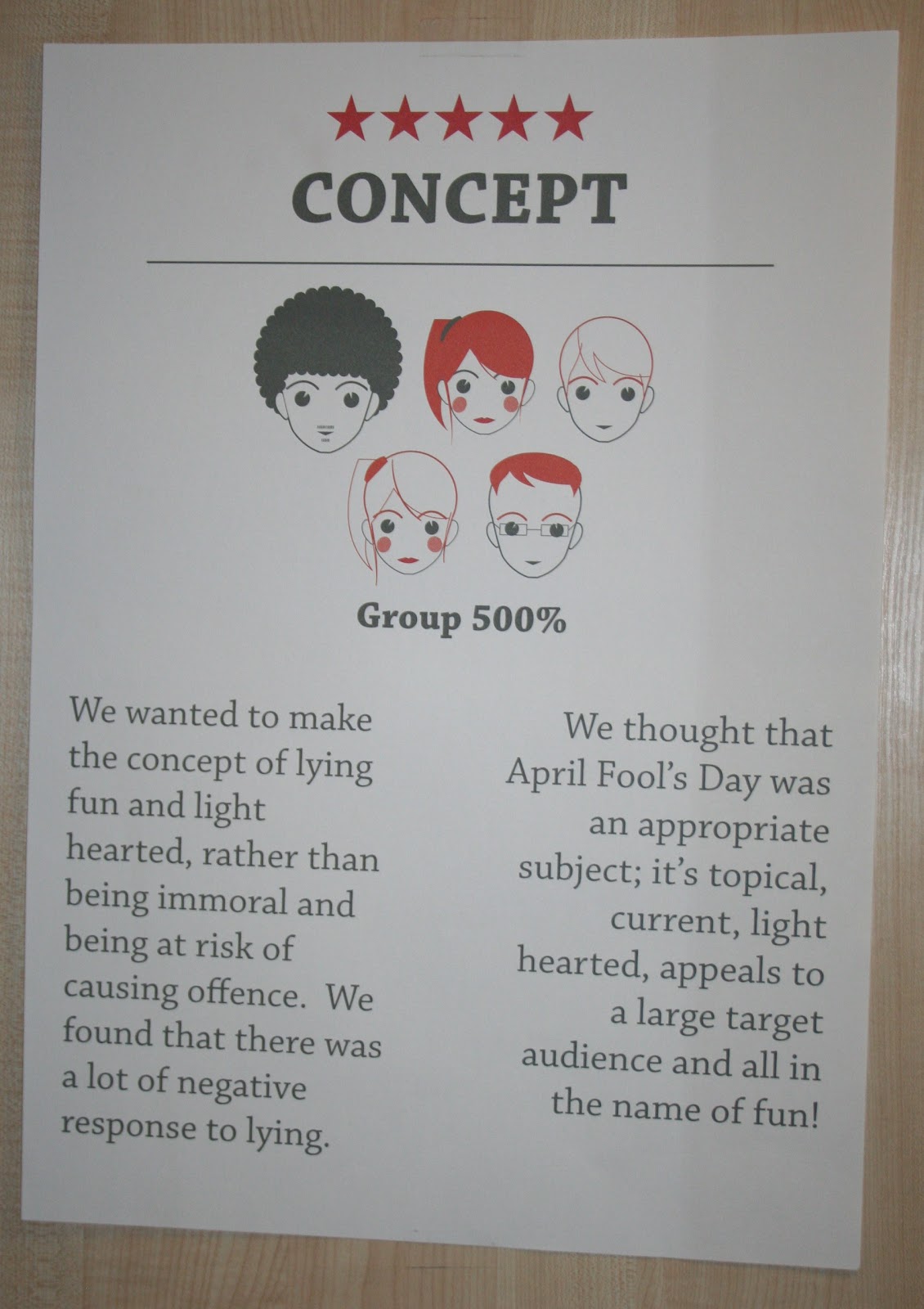
Communication is a Virus: Our Final Design Boards.


Generally, I was quite pleased with the re-visited content, concept and method of delivery presentation boards. I think that they communicated clearly and concisely whilst still maintaining a visual consistency with the two chosen colours plus stock, an illustrative house style and the set typeface- along with the equal balance of illustrations and type that we tried to represent in our final product of the books and poster designs.

Sunday, 27 March 2011

Communication Is A Virus: Written feeback for Group 6.


Written copy of my feedback to be delivered with our paired group- #6 on Monday morning's de-briefing session.

Feedback from Group 4 to Group 6
Written by Sophie Wilson

Overall, we felt very impressed by your project- your blogs evidenced a wealth of primary and secondary source research which was well linked through your design practice to your design context. A good range of source material demonstrated your design developments well.

We felt that the outcomes had been well considered, and the experimentation was evident. However, you could perhaps consider expanding this further by altering the scales of your written quotes, the locations (perhaps in a slightly more “safe” environment- where they would be seen but not trodden on- by a plinth or statue in a park perhaps?), and even the material used to create them- perhaps experimenting with colours, textures and different typefaces also.

We also feel that you could consider the further documentation and feedback from your outcomes- whilst it was evident that it was a success to a point- it would have been interesting to gauge people’s responses in a questionnaire or personal quote- finding out whether this would inspire them to go on and read further.

A really strong project, evidently showcasing good team work and a balanced effort; but, most importantly- answering the brief in a professional and creative application of design.

Friday, 25 March 2011

Communication is a virus: Feedback from Group #2.


In the presentation session today, we delivered our three concept, content and method of delivery boards along with our powerpoint presentation. In the afternoon session, each group was designated a specific group to recieve feedback from- our's being group 2 (which consisted of Beth Yates, Charlie Crosby, Joe Warburton and Luke O'Brien- aka the God's of graphic design...), this is the feedback we recieved...
-Enjoy the idea- though not really communicating well as a lie, more of a "con", and focusing too much on the commodity of the book. Didn't really feel that the prank was a lie.
-Didn't understand the transaction from poster pranks to fools- they liked the poster idea, and felt that we should have ran with this. They liked the simplistic, "anti-design", designed to camoflauge into every day, mundande design and sigange.
-Thought the idea of the blog is effective- more ranges of media. Pranks itself could have been the media too.
-Pranks might have worked better as the "trying something new" brief.
-Ask more people to perform the pranks.
-Didn't understand the audience we were trying to target.
-Try outside of the class/college environment.
-Need to think more about the motives of our design.


Although it may seem a little negative, I was actually really pleased with the responses we got, and fully agreed with every point raised. I felt the points were very constructive- some of which we had discussed, or faced problems with in the past.
As I have gone into more detail with from some of my blog posts, our group faced a great deal of problems and indecisions along the way- many of which we verbally highlighted in our presentation- that we felt the poster pranks idea was hard to resolve/create an outcome from, and that we felt the brief itself had proved very challenging.

If time allowed, I would really like to take some of their tips and perhaps go on to develop more designs- on a more expanded scale- perhaps going out into the public and applying some of these posters more liberally to gauge a response- however, as a group I am not sure that everyone would be enthusiastic to expand this further. I will engage a discussion and try to gain mementom once more, though if not, I will try my best to possibly develop this further.

Although we really did enjoy the poster prank stage of development, we found it came to a lot of dead-ends and problems throughout the course of the experimentations- so it's been really great to get another perspective and encouragement to persue this and be assured that it was infact a good idea, and that it has much more potential for development.

Communication is a Virus: Group 6 Project Feedback.


In the group presentation and feedback sessions today, each group were assigned a group to give specific crit and feedback advice and guidance to.
Our group (#4) were paired with group #6 whose group memebers included:

Kirsty Fruin
Will Cotterill
Chris Lawson
Ben Harwood and
Max Gregory

(see blogs below...)


They choice the breif subject "Get people to read more" and had a fluid and concise presentation with an effective outcome- whereupon they used stencils to create a typographic flour pattern on pavements- attracting passers by as a temporary arts piece.

This is a brief summary of the feedback we gave after watching their presentation and analysing their blogs collectively (to be written up in a critical analysis over the weekend to produce for them to type up onto their PPD blogs)...


-Good research and linking design practice to design context in blogs.
-Exisiting poster layouts, quotes and type- good considerations for the brief.
-Looked at text within the enviroment, but would benefit from gauging responses for a more defined view of how effective their outcome was. It was proven to make people read- but did it inspire them to do so more frequently afterwards?
-Specific research to product outcome evident on blogs- though could perhaps elaborate on this development a little more- go out there and create the designs as oppossed to just talking about them (though we understand time is limited).
-Good planning and research- perhaps, however, a little too negative. Statistics and solid quantative research would increase the believability and truth that people don't infact read (if this is infact the case).
-Good distribution and communication as a live brief, but perhaps make a more permanent source for their project- getting to physically read up tips, advice etc- a follow-on from what you are already doing. Perhaps adding a reading list to create examples of what people could be reading- the quotes were not specifically catered for an audience.
-Good development of work on design practice blogs.
-Consider where you present the work- perhaps make it a little more scenic and less vulnerable to wearing (potentially increasing the amount of people that would see it, therefore, increase it's effectiveness)- a place where people would walk, but not walk over it.
-Good method of delivery with the postcards- a bridge between the temporary and the permanent.


In our feedback presentation, the group seemed really responsive and positive about our comments (and were very polite- thank goodness!)- it was a really positive experience for us, and a chance to be constructive in a formal enviroment. I hope we have helped the group, and perhaps given them a new perspective on slight changes they could make.

However, I believe they generally had a really strong project and showed good development which resulting in them successfully answering the brief- and, as I said in their session, they can be pretty proud of the work- and themselves!

Wednesday, 23 March 2011

Formative Feedback and Progress Review.


An overview of the topics and comments discussed with through my Easter-time progress tutorial with tutor Amber...
ISSUES DISCUSSED AT THE TUTORIAL:

-Good attendance and envolvment with the programme.
-Range of techniques and processes in preperation for final solution.
-Evidence all development.
-Listen to  feedback from staff and students.

(TUTOR) ACTION:

-CTS>Completed
-Elective>To be completed over easter (creative writing)

STUDENT ACTION:

-Connect blog DP>DC>DP>DC etc...
-PPD up to date


I really enjoyed my tutorial session with tutor Amber and felt a lot more assured about my progress as a result.
I can certainly see some of the points Amber raised, such as not being so defensive about my work (usually caused by my rambling in crit sessions!) and to experiment more with materials and techniques- which I have begun to reflect on not only from this session but from my module feedback last week.

I will certainly do must best to work on these points, and keep working as hard as I can to get the most out of this demanding yet ultimately rewarding course.

Good times.

Friday, 18 March 2011

Idea Development and Progress Crit.


This morning, with our progress crit looming for 11.30, Yafet, Liam and I (sadly Sadie was at the dentist's and Michael was AWOL) sat down and talked about our development- and looked over some images that I had printed from the past week to show to tutor Jo in our progression tutorial.

We liked the idea of creating an infographics guide about April Fools' day- containing Fools (sort of like a double bluff) that we had begun to discuss and experiment with designs for yesterday.
Whilst talking about the origins of April's Fool Day- we had a bright idea... creating an April Fools' around the world guide- about the "true" *wink wink* traditions and hoaxes played in countries around the world on April 1st...

We began to make a list of countries, and stopped at around one hundered when our brains had fried- and Liam innovately came up with the name 

"Around the world in 80 fools.."
We began to write a list of potential fools. All could be true, though would certainly make you question them (most built on traditions or facts of the specific countries, therefore, naturally making them seem more realistic)...
- In Peru they sacrifice a llama to bring good luck to villagers in fear of getting fooled.
-In Bert's tearoom (West Yorkshire), for one hour, all tea leaves are switched with coffee granuels.
-On April Fools' day, one of the Queen's Grenadier guards swaps his bearskin hat for a taxidermied sloth bear.
 -On April Fools' Day in Greece, the late night "plate smash" event is parodied by attempting to smash melamime plastic plates to fool the customers.
-For two hours in Eygpt, a blow-up pyramid is erected to fool tourists on coach tours of the historical sites.

We also considered our methods of production and audience...
Audience:

-Sociologists, people interested in social history; geography, traditions (April Fools'), Book and Design lovers.
Methods:

-Poster/Small booklets/Hot dog
-Website link

As we discussed this idea, we considered linking a booklet with this fake stories to a website- telling the reader that they had been fooled- but then, go on to give them hints and tips as to how they can use our methods to fool others.
****

We presented these, as well as our developmental ideas (we had developed throughout the week) to Jo in our progress tutorial- and she seemed to like the majority of our ideas and the direction we had taken since our last crit- however, she felt that our ideas for our final product had strayed a little too far from the briefing- and the country elements could perhaps alienate many people- and not really making them care whether or not they had been fooled- as many people would have no idea about certain cultures and presume the stories to be true.
Of course, when discussing it we could completely understand, and she really helped us to recognise our strengths so far, and the direction in which we should be heading- where we tell the lies, as we have shown often proves successful from our posters around the university building, and perhaps analysing them to show others how they work.

We considered these points:

-Fooling people outright, or giving them clues? An odd-one-out guessing game.
-How to fool/How to spot a fooler.

-How you get tricked (what makes a lie convincing) and how to avoid.

-Re-designing content, concept and method of delivery boards for Friday's presentation.

CONTEXT TO REVIEW:
david schrigley
the darwin awards

****

Yafet, Liam and I re-grouped and talked about potential design developments...

-Top ten April Fools' pranks and examples
-Types of April Fools' and how to master them
-Odd one out: Guess which fool is a lie, or you are the fool
-How to look out for fools- detective notes of what to look for
-April Fools'...and how to get away with them

-Top ten April Fools' 
How people responded
Why it worked
How to develop a lie of your own (Researching lies we can re-create)

and after another chat with Jo, this is what we have finally decided...

"
How to create an effective April Fool, with inspiration from the greats"

...a booklet guide with our "top ten April Fool's jokes/pranks/lies/hoaxes.

We will have the original April Fool written down, how we went about performing it (re-creating to verify that the fool works on a day-to-day basis, and without elaborate expenses, etc) and then how to create it at home for yourself.

We felt that this idea covered all interpretations of the brief- to lie convincingly (as we will also perform the hoaxes) but also how to get others to lie too.

THE PLAN OF ACTION

Research famous April Fool's pranks...

Filter out the best ones...

Filter out ones that we could re-create...

Discuss with group to create designs which we agree are best suited