Tuesday, 15 March 2011

End of Module Grade: OUGD102.


After receiving our module grades yesterday, i was quite pleased with my result of 65%, a 2% increase from the first module. I felt as though I had put a great deal more effort, and slowly but surely my skills are developing- and now I intend to push this even further and this grade has inspired me to work harder still, and really consider the each brief and the limits I can put it, and myself to on the very first day of briefing. 

Points I believe I have to ammend and particularly pick up upon:

-Experimentation of method and techniques.
-Visual Research (Design Context).
-Personal and Professional reflection and evaluation of a frequent basis.
-Going back and ammending projects if they weren't right the first time- don't be lazy!
I just really hope that my work can keep improving and my grade increasing in this way, and that I will always strive to do my very best.

Action Plan and Time Management: What Is a Line?


Planning the next five weeks out for our visual language 'What Is a Line' brief, in order to remain as focused and prepared for the work load...

POINTS TO CONSIDER:
-research
-theme
-processes
-techniques
-experiments
-media used

FOR 22nd MARCH LESSON: 
-Find four books to enrich my research, based on astronomy/constellations


Action and Deadline:

1. Research theme- constellations; history of constellations, location, brightness, etc.
BLOG
Preliminary ideas- sketches and idea generation.

DEADLINE: 22nd March 2011 (one week today)

2. Generating primary and secondary research- an extension of research from previous week, design developments. 
Photography/Illustrations/Embriodery, etc.

DEADLINE: 29th March 2011 (two weeks time)

3. Experimentations, directed towards your brief- screenprinting/illustration- more focused.
Book layouts, folds, etc.
Typefaces/Typeface development- creating my own.

DEADLINE: 5th April (three weeks time)

4. Creating final outcomes and designs- focusing in on my final resolution- screenprinting illustrations for book- attend screenprint sessions and book binding.

DEADLINE: 19th April (five weeks time)

5. Evaluation of project, final PPD write-up, etc.
DEADLINE: 26th April (six weeks time)


SIGNED: Sophie Wilson
and Eddie Cooper (re-writer of brief)

What Is a Line: Brief Re-Write.


With an assigned partner in the group, mine being fellow moustache enthusiast, Eddie Cooper, we went on to re-write one another's briefs- really useful in getting a new angle and perspective of the potential for our brief and plans for the project...

BRIEF TITLE:
What Is a Line
The Brief:
Explore visual representations of constellations by indicating position, connection or boundaries. What makes a line unique, and how is this put into a book format?

Considerations:

Research all lines, using a variety of sources and collect information to develop visual interpretations, compositions and layouts. Look at book binding and how it's outcome could become part of the book.

Target Audience:
-Any-one interested in astronomy

Tone of Voice:
-Informative
-Clear- not specific to any age range
-Not too scientific

Background:
A range of primary and secondary research exploring every aspect of constellations.
Photograph the stars.

Mandatory Requirements:
-Visual Samples
-Research 
-Blogging

Deliverables:
A book with all the information and outcomes.

Studio Deadline:
26th April 2011.

NB: Sorry Sophie, you pretty much had this brief BANG ON


^^love that note.

Eddie's re-write of my brief has really helped me to focus in more on my visual outcomes and ideas. I was already beginning to consider my final outcome pre-experimentation, and had thought of maybe creating a book or a poster series, so it's good to know that someone else considers this as a viable and positive outcome too.

What Is a Line: Constellations.


Writing our own briefs with a template outline for the 'What Is a Line' visual language project...

BRIEF TITLE:
What Is a Line: Constellations.
The Brief:
Explore visual representations of constellations by indicating positions, connection or boundaries- create a series exploring what links the eighty-eight constellation series, as well as what makes each one unique.

Considerations:
Research will be essential for the progression of my outcome- using a variety of sources to collect information to develop visual interpretations, composition and layout.

Target Audience:
Anyone interested in astronomy, space travel, and star gazing/constellations.
With a clear, concise and informative langauge, the guide will have a wide audience (in regards to age range).

Tone of Voice:
Informative, clear- not specific to any age range- not too formal or scientific- a beginner's guide so as not to alienate a large portion of my potential audience.

Background:
I will collect a wealth of both primary and secondary research. I will photograph stars and constellations, explore illustration and printing methods (screenprinting, monoprinting, etc.)

Mandatory Requirements:
Produce a vast quantity of visual samples and research, in order to develop and distinguish the direction and visual format which my work is most suited to.

Deliverables:
Produce a wide collection of visual experimentation and research centered around my theme- explore visual communication within outcomes- produce a visual guide of the 88 constellations.

Studio Deadline:
26th April 2011 (Module Deadline)

Sunday, 13 March 2011

Progress Crit and Developments of the Day.


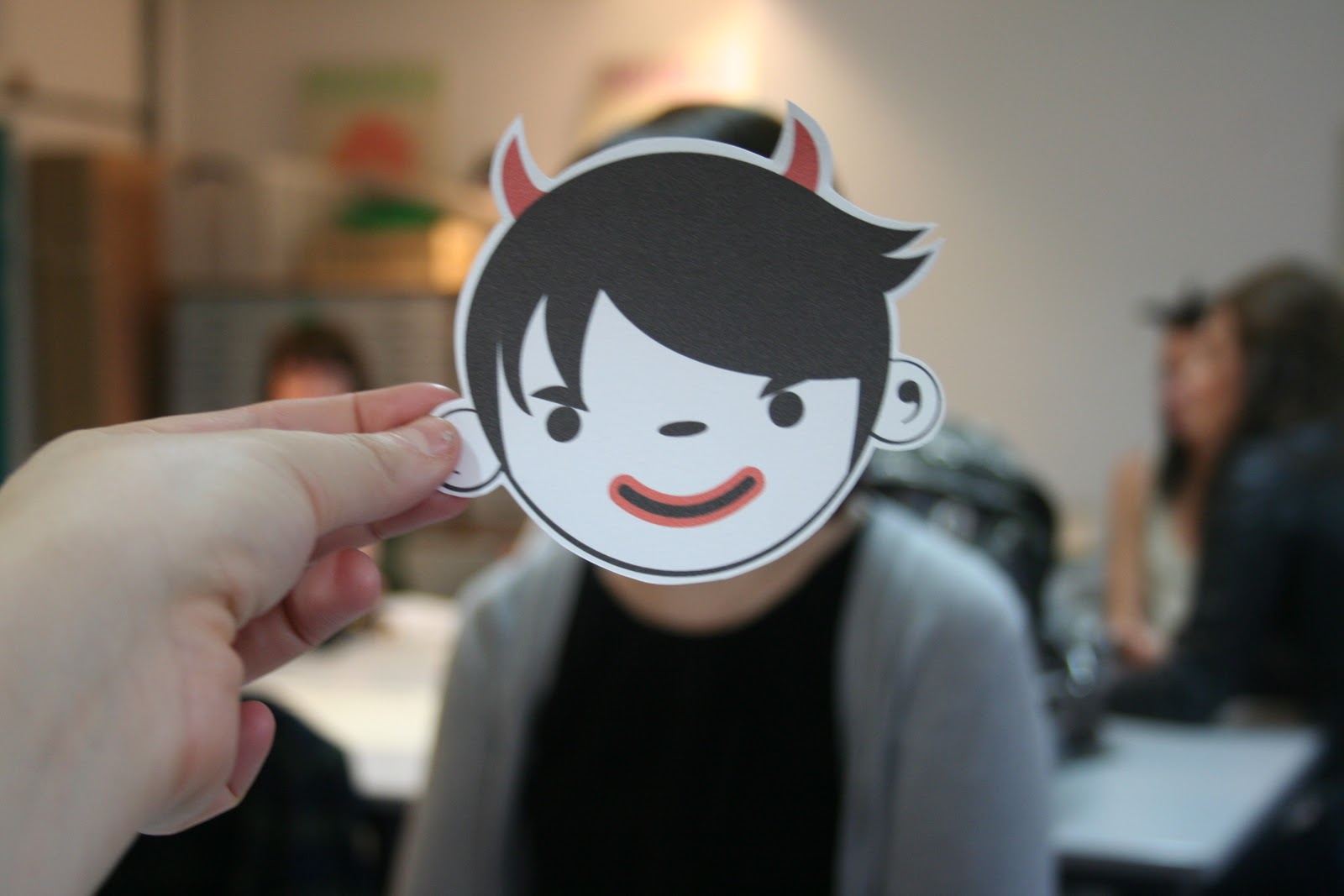
...Creating angel and devil mini masks- designs for stickers in a "progress file" at the back of our book- for children to record whether they have got away with a lie, or have been caught out (above).

With progress boards ready, and everyone ~in the know~ as to what our project was about, and what our ambitions were, we started to plan scenarios for our book, and topics that could be featured- along with layout and design...


We went into our progress crit wishfully thinking that our efforts would communicate effectively. Undoubtedly, there were many criticisms in the brief- and we came to realise that our project had many flaws including:
-the consideration of our age range (5-9 years)- perhaps too broad- at 5, can children read this well? can they lie effectively? at 9, do they really want a child-like book such as this? perhaps we have the wrong target audience, could this be targeted to nostalgic adults instead?
-our problem- we set out to create a solution to "get to lie convincingly", as whilst a few of our "solutions" to scenarios may have done this, many were silly but ultimately child-friendly and playful- not seriously helpful.

After a discussion with tutors Jo and Amber, we felt it would be better to go for a more generalised audience, and to take a step back from focusing our design so much- although taking some of the elements to inspire a new path.
As prompted by Amber, we have decided to become ~the liars~ ourselves, creating phony and surreal circumstances to see how people respond to them. For example...creating a "missing spider" advertisement (like a "lost cat")- making it silly yet convincingly written- and with a huge reward- see how many respond. Altering signs in parks and the environment- making people consider the wording and think more carefully about the demands. Instead of "don't walk on the grass", we could have "don't walk on the grass...until you have taken your shoes off".

At the minute, we're not entirely sure which direction we're going to follow- though we know we want to make it a live brief- going out into the public and actually display these altered signs, though, for now, I think that's no bad thing- It'll be good to get a fresh view on the project and perhaps think more creatively than we were previously.

Wednesday, 9 March 2011

'Opposites' Compeition Brief: Final Posters.


The three final posters to submit to the competition brief. I am pleased with the results I achieved, and the research put into my designs considering the short deadline of the brief- though I understand, in hindsight, and from tutorials that my visual communication, once more needed ammending, and hope to remember that complexity isn't always the answer.

Tuesday, 8 March 2011

Ideas and Concepts Workshop: What is a Line Brief.


Sitting in groups, we started to brainstorm concepts and methods in how we could go about experimenting and designing for this brief.

Working with Lisa, Beth, Baljeet, and Sarah, we firstly gathered a range of method and technique approaches...

1. Photography
2. Moving Image
3. Illustration- hand trace/doodling
4. Digital Illustration
5. Embroidery
6. Book Crafts
7. Screen Print
8. 3D Crafts
9. Papercraft
10. Silkscreen
11. Vinyl Cutting
12. Collage/ De Coupage
13. Measured/Technical Drawing
14. Life Drawing
15. Typography
16. Painting
17. Monoprint/Collagraph
18. Stencils- wood, paper, vinyl
19. Mark making- engraving, embossing, etching, chemical
20. Laser cut stickers
21. Letterpress


And then gathered a range of themes we could possibly work on...

1. Constellations
2. Mazes and Labyrinths
3. Palmistry
4. Maps and Contour Lines
5. Hidden Shapes in Stacked Objects
6. Teams
7. Family Trees
8. Buildings/Silhouettes
9. Faces
10. Choose an event 
11. Choose an every day object- eg tables
12. Hair
13. Journey
14. Bird on a Wire
15. Evolution
16. String
17. Rings in a tree trunk- nature
18. Horizon- sunsets
19. Action (sports)- footballer kicking a football, etc.
20. Timeline of a life
21. Memorable events
22. Document a day
23. Formation of people- band, crowd.

****

After we discussed these points, and shared them with the group by sticking posters to the walls, we went on to fashion our own combinations- approaches to the brief. The few I wrote were...

1. Constellations in illustration- a booklet/guide to stargazing

2. Screenprinting palmistry posters

3. Papercutting strings- Making balls of papercut materials and photographing for a continous line booklet.

4. Representing music through typography- represent musical notes on sheet music by the words in the musical piece.

5. Create a moving image, animate piece about hair growth- almost a "time lapse" style- weird and wonderful hair styles.

6. Create stencil booklet of patterns involving lines- DIY book for printers and designers.

7. Create an instructional booklet on how to embroid your own constellation patterns.

8. Make an over-layed papercut booklet on how to distinguish trees- textured lines and rings distinguishing age, species, etc.

9. Make an animation (moving image) about the quintessential Britishness of ques- an info guide for foreign travellers- the dialect of Britishness.

10. Screenprinted posters based upon "the evolution of man"- could break down to parody in smaller groups:

"the evolution of the businessman"
"the evolution of the lazy man"
"the evolution of the handsome man"...etc...

11. Design a fanzine about hair types- illustrative or photographic? Quotes and typography encorporated into the designs?

12. Screenprint posters about hair- different textures.


Discussing my three favourite ideas with my group- numbers: 1, 11, and 12- they warmed to the idea of constellations, though i was unsure about the this and was favouring the hair idea, and the constellations work would take me a great deal of time to research, and this may compromise the final design quality. 

We went on to present our three favourite approaches ideas to another member of the class (not sitting in our friend groups on our table) and the hair fanzine was chosen as "the best idea"...with...

"achievable and it would be interesting to view. I think it would work really nice illustratively"

However, I was still unsure.

When I asked tutor Amber which she felt would work best, she suggested I work on the constellations idea- having looked at moustaches for my previous Collection 100 project, she felt it would push my limits and allow me to experiment more- and not run the risk of just extending a previous project.

Constellations it is!

At the moment, I am considering combining the two responses to make a fanzine based on constellations, but have to ensure that I don't stray from the brief- I will now go to on research constellations, in both primary and secondary sources to post on my design context blog.